November 5, 2026
A bookmark manager you can leave: local-first options compared
The question "is there a bookmark manager without an account" usually mixes two different needs:
- No account: too much friction, or unwilling to hand over an email address.
- No lock-in: an account is fine, but the data must come out whole, and the service shutting down must not mean losing everything.
The solutions are different. The first only accepts genuinely local setups; the second just needs a hosted service with real export. Separating them saves a lot of trial and error.
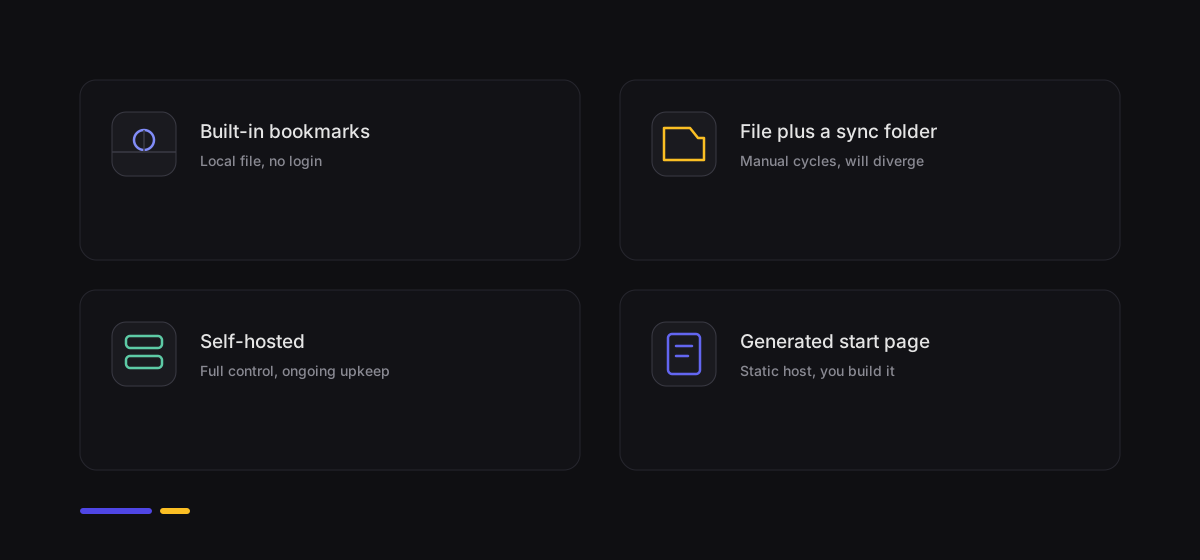
Option one: built-in browser bookmarks
The closest thing to zero cost and zero account. Chrome, Edge, and Firefox all work without signing in, storing bookmarks in a local file.
The costs:
- Sync requires an account. No login means no cross-device; moving computers means manual export and import.
- No body-text search, no notes.
- One list per browser, no overlap.
Fits: one browser, one device, under a hundred bookmarks. That range is larger than people expect — many users never leave it.
Option two: the bookmark file plus a sync folder
Export to HTML, drop it in Dropbox, iCloud Drive, or OneDrive, download and import on another device when needed.
The costs:
- No real-time sync; every transfer is a manual cycle.
- Files diverge: two devices each import and each add, and within days you have two different lists.
- An HTML file has no search. You are down to a text editor or a script.
"Workable but annoying" — fine if you reorganize once every couple of months.
Option three: self-hosted
Open-source projects like linkding or Karakeep running on a NAS or a small server. Data stays entirely local; extensions, search, and tags are all there.
The costs:
- A machine that stays online, plus basic Docker literacy.
- Backups, upgrades, certificates, and domains are your problem.
- Remote access needs a tunnel or reverse proxy, which is where most people stop.
Fits: you already run a NAS, you have a specific position on data sovereignty, and you accept the ops work.
Option four: generate your own start page
Shape your bookmarks into a static HTML or JSON file hosted on GitHub Pages or Cloudflare Pages. No backend, no account, and it opens as a page.
The costs:
- You build it, or find a generator. Changing one bookmark means editing a file, committing, and waiting for a deploy.
- No dynamic features beyond search; bulk editing, import, and deduplication are yours to write.
- It is a personal webpage, not a product.
Fits: you write frontend code, your collection is stable, and you change it a few times a year.
Side by side
| Option | Account needed | Cross-device | Search | Upkeep |
|---|---|---|---|---|
| Built-in | No (sync does) | Needs account | Title/URL only | None |
| File + sync folder | No (cloud does) | Manual | No | Monthly |
| Self-hosted | No (you host it) | Your problem | Yes | Ongoing |
| Static start page | No | Built in | You build it | Deploy per edit |
Which one you actually need
Three questions:
- Will you change devices within a year? If yes, pure local is out.
- Will you add bookmarks from more than one device? If yes, you need real sync — file-based options fail on divergence.
- Will you pay for "nothing to manage"? If yes, hosted is easiest. If no, accept the cost of self-hosting or manual cycles.
One honest note
MyNav is not in any of the four categories above: it needs an account and a connection, and it is not a local-first product. What it does address is the third need — the data comes out whole. Even the free plan exports JSON (including notes and text-only cards) and HTML (which any browser imports back), with the formats documented on the settings page.
If your requirement is strictly "no account at all", look at option one or three. If it is "an account is fine, but no lock-in", then there is only one test: can this tool hand you all your data in a common format, right now? That test applies to every tool in this category, including ours.
After exporting, verify the result with the bookmark file checker — counts and duplicates are enough to spot a bad export.